Dead Mountain: What Happened at Dyatlov Pass in 1959
Nine experienced hikers cut their way out of their tent from the inside and walked into a blizzard at thirty below, some barefoot. None came back. Sixty-five years later, the file is still open.
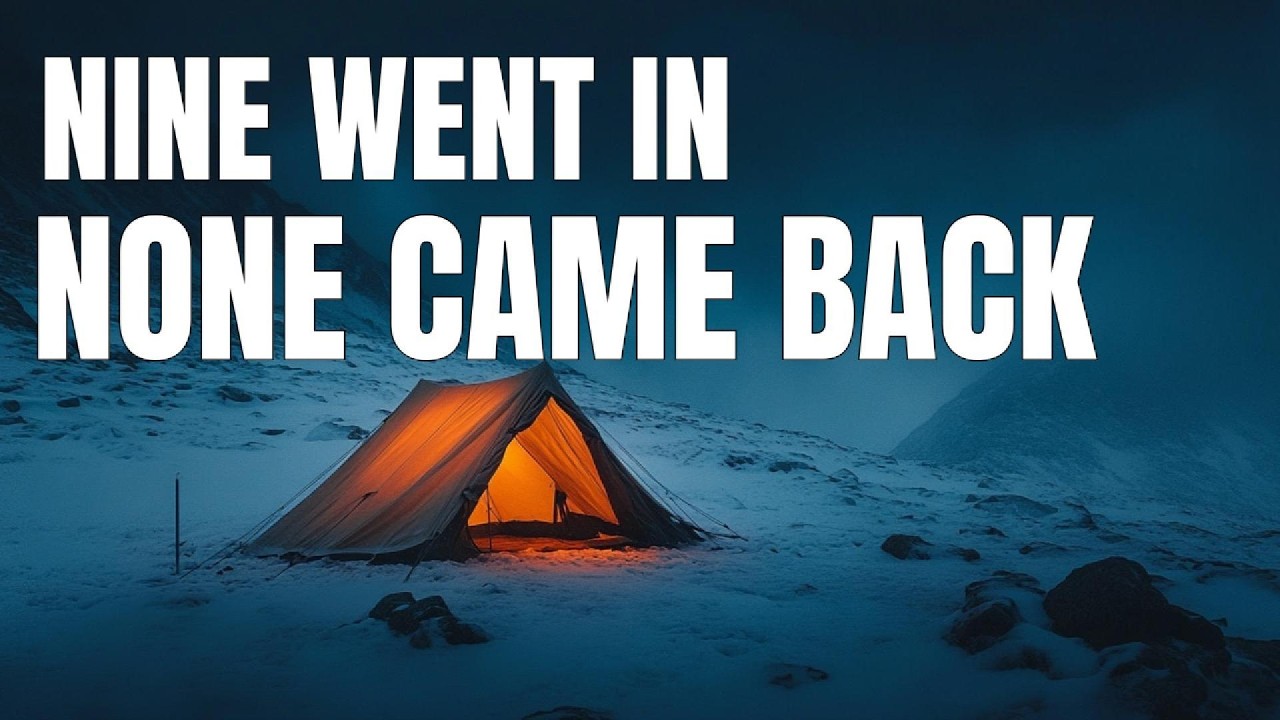
Nine experienced hikers went into the northern Urals in the winter of 1959. Every one of them knew the cold. Knew the mountains. Knew exactly what a night like that could do to a body.
And on the night of February first, something made all nine of them cut their way out of their own tent — from the inside — and walk into a blizzard, in the dark, some of them barefoot, some in nothing but their underwear. They left behind their boots. Their coats. Their food. Everything that could have kept them alive. The temperature outside was thirty below. Not one of them came back.
The group
They were students, mostly, from the Ural Polytechnic Institute. Young, fit, and serious about the mountains. Their leader was Igor Dyatlov — twenty-three years old, a gifted skier, the kind of person other people trusted to bring them home. With him were seven more from the institute, and one older man: Semyon Zolotaryov, a war veteran, studying to become a certified mountain guide.
The plan was a winter trek to a mountain called Otorten. By Soviet standards it was a Category Three route — the most difficult there was. But every person on that trip had the training for it. This was not a group of tourists wandering somewhere they didn’t belong. They kept diaries. They took photographs. We know what they ate, what they joked about, what the weather did. The record is almost intimate. And then, on the first of February, the record stops.
The last camp
The plan had been simple: cross the pass, push toward Otorten, and check in by telegram when they came back down. When they reached the slope of a mountain the local Mansi people called Kholat Syakhl, the weather turned. In the language of the Mansi, the name means something close to “Dead Mountain.”
For reasons no one has ever fully explained, the group made camp high on the open slope — exposed, windswept — instead of dropping into the shelter of the tree line just over a kilometer below. Dyatlov knew better. Zolotaryov knew better. They did it anyway.
They cut a flat platform into the snow, raised the tent, and settled in for the night. The last photographs show them digging in: calm, ordinary, tired in the way people are at the end of a long day. Somewhere in the hours after that picture was taken, all nine of them ran for their lives.
The search and the cut tent
They were supposed to send a telegram around the twelfth of February. When it didn’t come, no one panicked at first — delays happened, the weather had been brutal. But by the twentieth, the families were demanding a search, and volunteers and soldiers were sent into the mountains. On the twenty-sixth, they found the tent: half-collapsed, buried under snow, abandoned on the open slope. And when investigators examined it, they found something that made no sense.
The tent had been cut open from the inside. Slashed. Someone had taken a knife to the fabric from within and torn their way out, rather than use the entrance. A forensic expert later confirmed it: the cuts came from inside the tent. Whatever drove these people out, they were so desperate to escape it that they didn’t stop to open the door.
Outside, the footprints told the next part. Tracks led away from the tent, downhill, toward the forest — eight, maybe nine sets of them. And here is the first detail the easy answers struggle with: the footprints were not the prints of people running in blind panic. They were spaced like people walking, at a normal pace, away from the only shelter they had, into a blizzard, in the dark.
The cedar
The first bodies were found near a tall cedar tree, just under a mile downhill from the tent. Two of them, lying in the snow, wearing almost nothing — socks and underwear, in thirty below zero. Near them, the remains of a small fire. Branches on the cedar were broken as high as five meters up, as if someone had climbed it — to look for something, or to see back toward the tent.
Between the cedar and the tent, three more bodies were found, including Dyatlov himself. They were spread out along the line back toward the camp, as if they had died trying to return to it. Their deaths were consistent with hypothermia — the slow, quiet way the cold takes a person who has run out of heat. Five found. Four still missing.
For weeks, the mountain kept them. And what investigators pieced together from those five was strange enough on its own. But it was the last four — found two months later, when the snow began to melt — that turned this from a tragedy into a mystery that has never closed.
The ravine
In May, the snow gave them up. Four bodies, in a ravine, under several meters of snow, deeper in the forest than the others. And these four had not died of cold alone.
Two had severe chest fractures. One had a major skull fracture. The kind of damage investigators compared to a car crash. And almost none of it showed on the outside. The ribs were shattered. The skull was broken. The skin above them was intact. Something had applied enormous pressure to these people without ever tearing them open.
One of them, Lyudmila Dubinina, was found missing her tongue and her eyes. She was face-down in a stream. Nine people. Two months apart. One mountain. And the investigation that was supposed to explain it lasted three more weeks — and then stopped.
The compelling force
The Soviet investigation closed the case in three weeks, with six words: the hikers died of a compelling natural force. They did not say what force. They did not say why. They sealed the file, and for thirty years, no one outside the state was allowed to read it.
So the answer had to come from somewhere else. In 2021, physicists put the mountain into a computer. And what came back was an avalanche — not a wall of snow, a slab. The group had cut into the slope to level ground for their tent. Under hard, wind-driven snow, that cut could have failed hours later: a block of snow, heavy as concrete, coming down onto the tent in the dark. And it fits. It explains why nine trained people would slash their way out of a tent instead of opening the door. It explains why they ran for the trees. It explains the crushing. For the first time in sixty years, the Dyatlov Pass had an answer.
And then you take that answer back up the mountain. The slope is under thirty degrees; avalanches need steeper. The men who reached that tent found no debris — no snow mass, nothing pushed downhill, no sign a slide had happened there. The tent was still standing enough to dig out. And the footprints were not the prints of people fleeing. They were evenly spaced. Measured. Nine people walking, one behind the other, away from the only shelter for a kilometer in any direction, in the dark, at thirty below. Nobody walks calmly away from an avalanche.
And there is something on that slope the avalanche cannot touch at all.
What the clothing said
The clothing from the ravine was sent to a radiological laboratory in Sverdlovsk. Nobody had asked for the test. The prosecutor ordered it himself, in May, three months after the bodies came down — and to this day, no one knows what made him think to look. The results came back with contamination: beta radiation, on fabric taken from the ravine bodies — a sweater, the waistband of another sweater, the cuff of a pair of trousers. Above the legal limit for a Soviet worker who handled radioactive material for a living.
And there was an explanation waiting. Georgy Krivonischenko was an engineer. Before this trip, he had worked at a facility called Mayak — a plutonium plant in the southern Urals. In 1957, a storage tank there exploded and contaminated an area the size of a small country. Krivonischenko was part of the cleanup. He resigned in 1958; his resignation letter said he was leaving out of a complete unwillingness to work in that system. He almost certainly carried contaminated clothing to those mountains. His family believed it too — they kept a suitcase of his things for years, afraid to open it, and in the end they buried it.
So the radiation is solved. Except the contamination was not on one man’s clothing. It was found on garments taken from the bodies in that ravine — and by the time they died, those nine people had been trading clothes with one another, pulling layers off the dead to survive the cold. The lab report describes contamination on separate items, in patches, on different bodies. One man from Mayak explains one man’s sweater. It does not explain the pattern. The prosecutor read that report, filed it, and closed the case three weeks later.
The last photograph
There is a photograph. The last frame on the last roll of film recovered from that camp. No one knows who took it, or when. The image is almost nothing — a blur of light in total darkness, out of focus, badly exposed. Some say it’s an accident, a camera going off in a pocket as a man fell. Some say it’s the last thing nine hikers ever saw.
Nine people climbed a mountain the Mansi called Dead Mountain. They knew the cold. They knew the route. They did everything their training told them to — right up until the moment something told them the safest place on that slope was anywhere but inside their own tent.
The file in Moscow is closed. The snow has melted and frozen sixty-five times since then. And the slope of Kholat Syakhl is still there — silent, white, and as empty as the night they ran. Nine people. One man from Mayak. The numbers never added up.
Reconstructed from the 1959 Soviet criminal case file, forensic records, and the official 2019–2020 reinvestigation. No images of the hikers or of the recovery are reproduced; visuals are atmospheric reconstructions created for the channel.
◆ Free Access ◆
Read the full dossier — free
Drop your email and unlock the complete case-file library as PDFs.
No spam. Just case files.
◆ Free Access ◆
Download every case file
Want the full dossier for this case — and every other one — as a PDF? Drop your email and unlock the complete library.
No spam. Just case files.